Ink Over Emoji: Why Sending a Handwritten Note Is the Boldest Thing You Can Do Right Now
Somewhere between the third unanswered text and the fifteenth push notification of the morning, something snapped for Dani Reyes, a 29-year-old graphic designer in Austin. She didn't delete her apps. She didn't go on a digital detox. She just bought a box of notecards and started writing.
"I sent my friend a card for her birthday instead of a text," Dani says. "She literally called me crying. I didn't realize how much it would mean — or honestly, how much it would mean to me to write it."
What Dani stumbled onto isn't exactly a secret anymore. Across the country, people are quietly rediscovering the handwritten note — not as some quaint throwback, but as a deliberate, almost radical act of presence in a world that keeps asking us to move faster.
The Message Behind the Medium
There's a reason a handwritten letter hits differently than a DM. It's not just sentiment — it's physics. Writing by hand is slow. It requires you to sit still, think before you commit ink to paper, and make choices you can't undo with a backspace key. Every crossed-out word, every slightly uneven line, every stamp you had to actually lick — it all adds up to something a text string simply cannot fake: effort.
And in 2025, effort is currency.
Social psychologists have long noted that the medium we choose to communicate with signals how much we value the recipient. Firing off a birthday text takes nine seconds. Writing a birthday card — finding it, sitting down, thinking about what you actually want to say — takes nine minutes at minimum. The recipient feels that difference even if they can't articulate why.
"There's an embodied quality to a handwritten note that digital communication just strips away," says one behavioral researcher who studies how technology shapes intimacy. "When you hold a letter someone wrote, you're holding something they touched. That's not nothing."
Paper Is Having a Moment (Again)
The stationery industry, which many had quietly written off as a casualty of the smartphone era, is seeing something unexpected: growth. Independent stationery shops in cities like Portland, Nashville, and Brooklyn report steady upticks in foot traffic. Etsy searches for personalized notecards and wax seal kits have climbed year over year. Even big-box retailers are expanding their paper goods sections.
It's not just older generations feeling nostalgic. Gen Z — the cohort that grew up texting before they could drive — is showing up in force. For a generation that has lived its entire social life on screens, pen and paper carries a kind of novelty that borders on subversive. Writing a letter feels like opting out, and opting out, right now, feels very on-brand.
That irony isn't lost on Marcus Webb, a 24-year-old college student in Chicago who started a "slow mail" pen pal exchange with a friend after they graduated and moved to different cities. "We text all the time, but the letters are different. I actually think about what I want to say. It's like — I'm not performing for an audience of one, I'm just talking to my friend."
The Ritual of It
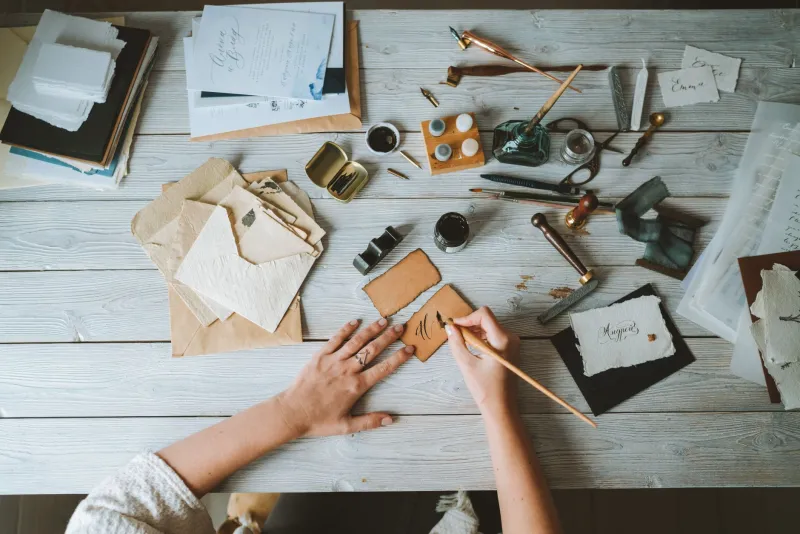
Ask anyone who's gotten into handwritten correspondence and they'll almost always mention the ritual. There's the hunt for the right pen (a surprisingly passionate topic). The choice of paper — lined, blank, heavyweight, textured. The moment of sitting down with no notifications demanding attention, just you and a blank page.
For many people, that ritual has become a form of mindfulness they didn't go looking for. Writing slowly forces you to be present in a way that typing rarely does. Your thoughts have to keep pace with your hand, not the other way around. And there's something about the physical act — the pressure of the pen, the scratch of nib on paper — that makes the experience feel grounded in a way that staring at a glowing rectangle simply doesn't.
Jennifer Castillo, a 41-year-old teacher in New Mexico, started writing thank-you notes to her students' parents at the end of each school year. "I used to send an email. It took two minutes and felt like nothing. Now I write a card for each family. It takes me a whole evening. But the responses I get — parents tell me they've kept the cards for years. One mom framed it."
That's the thing about a handwritten note: it sticks around. You don't archive it. You don't scroll past it. It sits on a desk, gets tucked into a drawer, sometimes lives on a fridge for months. It has a physical life that a text message simply doesn't.
Not a Rejection of Technology — A Supplement to It
It would be easy to frame the handwritten note revival as anti-tech, but that's not quite right. Most people who've embraced the practice still use their phones constantly. They're not trading one for the other — they're making a distinction about what deserves what.
Quick logistics? Text. A birthday shoutout to a coworker? Sure, a DM works. But a real thank-you? A note to a friend going through something hard? A letter to a grandparent? Those deserve more than autocorrect and a blue checkmark.
"I think we're getting better at matching the weight of the communication to the medium," says Dani. "Some things are text-sized. Some things are letter-sized. I just got confused about which was which for a while."
That recalibration — figuring out what actually deserves our full attention versus what can live in a notification — might be one of the defining cultural negotiations of this decade. And the humble notecard, it turns out, is one of the clearest ways people are drawing that line.
How to Actually Start
If you're intrigued but haven't picked up a pen for anything other than signing a receipt in years, the bar is lower than you think. You don't need beautiful handwriting. You don't need fancy stationery (though it helps make it fun). You just need something to say and someone worth saying it to.
Start small: a thank-you note after a dinner party, a card to a friend you've been meaning to reach out to, a letter to someone who helped you this year. Keep it short if you want. Two sentences in your own handwriting, in your own words, delivered through an actual mailbox, will land harder than a paragraph you typed with your thumbs.
The stamp costs sixty-eight cents. The feeling it leaves? That's harder to put a price on.
Somewhere out there, someone is about to open their mailbox and find something that isn't a bill or a catalog — something written just for them, by someone who sat down and meant every word. That's not nostalgia. That's just one human being choosing, very deliberately, to show up for another.
And honestly? That never went out of style.