Put Down the Playlist: The Best Dinner Parties Don't Need a Soundtrack
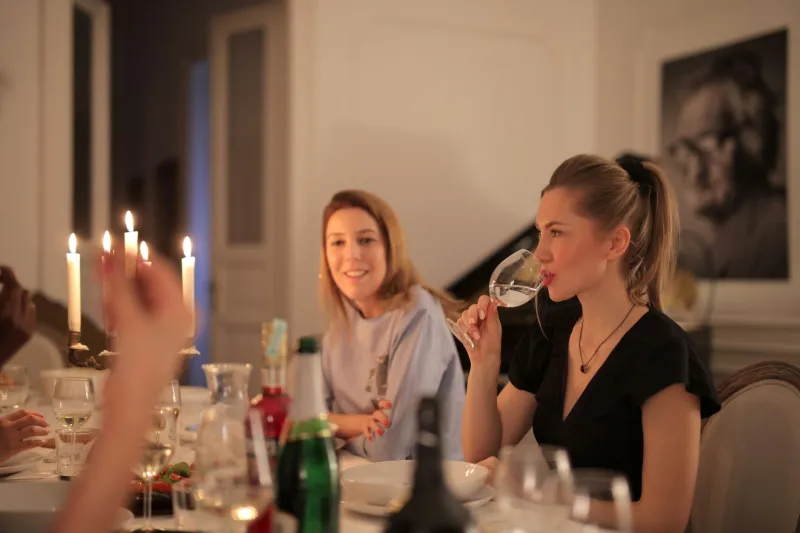
Somewhere between the third Pinterest board and the second round of tasting a signature cocktail you've been workshopping since Tuesday, the dinner party became a performance. And like most performances, it started leaving the audience cold.
Ask anyone who's hosted recently — really hosted, with the full spread of ambient lighting presets, a carefully sequenced playlist transitioning from "arrival jazz" to "dinner groove" to "winding down acoustic" — and they'll usually tell you the same thing. The food was great. The table looked amazing. But they can't quite remember what anyone actually talked about.
That's not a coincidence.
The Overcuration Trap
There's a version of hospitality that's become increasingly common in American homes over the last decade, and it looks a lot like event production. You've seen it. Maybe you've done it. The tablescape that took two hours. The custom playlist with a name like "Sunday Supper Vibes." The string lights, the candles at exactly the right height, the appetizers arranged with tweezers.
None of this is inherently bad. But there's a point at which all that effort stops serving the guests and starts serving the host's anxiety. When the goal shifts from connection to impression, something quietly breaks down.
"I used to spend more time on the Spotify queue than on the actual food," says Marisol, a graphic designer in Austin who hosts monthly dinners for a rotating group of friends and colleagues. "I had transitions mapped out. I genuinely thought that was what made a good host. And then one night my speaker died mid-dinner and we just... talked. For four hours straight. It was the best night we'd had in years."
Her speaker has stayed off ever since.
What Silence Actually Does
There's real psychology behind this. Ambient noise — even pleasant, carefully chosen ambient noise — competes with conversation in ways we don't always register consciously. Our brains are constantly parsing sound, and background music, no matter how tasteful, demands a small but real share of cognitive bandwidth. Add that to the visual stimulation of a beautifully set table, the social processing of reading the room, and the simple effort of keeping up with conversation, and you've got a lot going on.
Strip some of that away, and something opens up. The silences feel less awkward, not more. People lean in. Stories get longer. Tangents happen. And tangents, it turns out, are where the good stuff lives.
"The best conversations I've ever had at a dinner table weren't planned," says Devon, a high school teacher in Portland who hosts a semi-regular supper club with a no-phones, no-music policy that guests initially push back on. "Someone always complains at the start. By the end, nobody wants to leave."
The Paradox of Preparation
Here's the uncomfortable truth about over-prepared dinner parties: all that effort can actually signal distrust. When every moment is curated, guests unconsciously pick up on the fact that the host is managing the experience rather than sharing it. It creates distance dressed up as warmth.
The hosts who are remembered as legendary — the ones people talk about for years, whose invitations get RSVPed immediately — tend to share a different quality. They're present. The food might be simpler. The lighting might just be regular lamps. But they're actually in the room with you, not running a production from behind the scenes.
"I stopped trying to control the vibe," says Marcus, a photographer in Chicago who hosts big, chaotic potluck dinners where the menu is never certain until the guests arrive. "Now I just make sure there's enough wine and a table big enough for everyone. The rest takes care of itself. Always."
That's not laziness — that's a different kind of intentionality. One that prioritizes people over aesthetics.
Practical Ways to Actually Host Less
If you're ready to experiment, here are a few low-stakes ways to start pulling back the production:
Skip the playlist entirely. Or at minimum, put it on shuffle and never touch it again after guests arrive. If the conversation dies, it dies — that's information, not a crisis.
Simplify the table. One centerpiece, not five. Candles are always good; everything else is negotiable. Your guests are not judging the napkin fold.
Make one thing really well instead of six things adequately. A great roast chicken and some good bread beats a six-course tasting menu you're stressed about all night. Fed and relaxed beats impressed and tense every time.
Ban the group photo until the end. Or don't take one at all. The moment you pull out a phone for a "quick pic," you've reminded everyone that this evening is content. Let it just be an evening.
Ask one real question at the table. Not "how's work" — something with some texture to it. What's something you changed your mind about recently? What's a place you've been that surprised you? One genuine question can carry a whole dinner.
The Real Flex Is Presence
There's a cultural shift happening around what it means to be a good host, and it's moving away from production value and back toward something older and simpler. The dinner party as a place where people actually meet each other — not the curated versions they perform online, but the real, rambling, contradictory, funny, weird versions that only show up when there's nowhere else to be and nothing else to look at.
That's the thing no playlist can manufacture and no tablescape can fake. It only happens when you stop filling every second with something and trust that the people in the room are enough.
They usually are.
So next time you're hosting, maybe close the laptop before you open Spotify. Maybe light a candle instead of setting a scene. Make something good to eat, open the door, and see what happens when you get out of the way.
The conversation might surprise you.


