Whisper or Shout? The Fashion Debate That's Actually About Who We Are
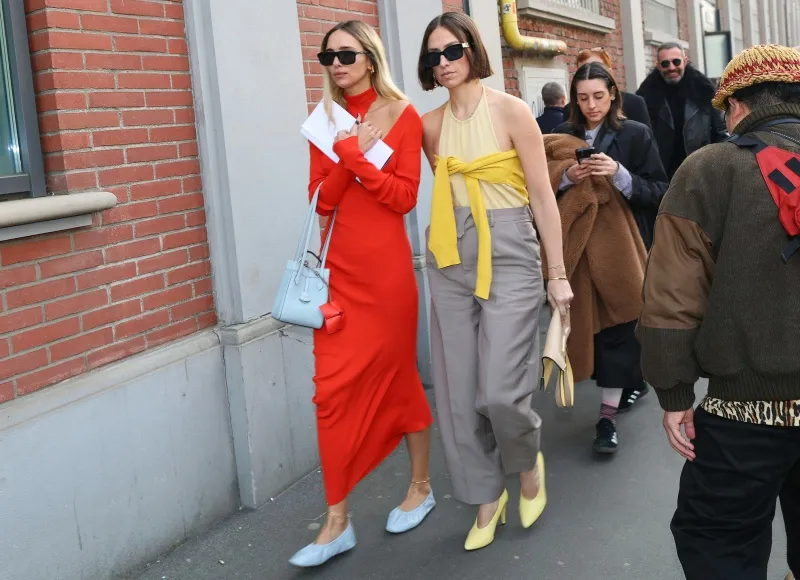
Photo: fashion contrast minimalist neutral outfit versus colorful maximalist streetwear, via assets.vogue.com
Picture two outfits. The first: a perfectly cut camel overcoat, slim-fit ivory trousers, leather loafers in a shade that splits the difference between tan and cream. No logos. No patterns. Not a single element fighting for attention. The second: a bright cobalt tracksuit layered with chunky gold chains, a graphic tee, neon sneakers, and a bag that announces its brand from across the room. Both outfits cost roughly the same amount of money. Both wearers feel completely, confidently themselves.
This is the central tension playing out across American fashion right now — and it goes way deeper than clothes.
Defining the Divide
The first look has a name you've probably heard by now: quiet luxury. The aesthetic — sometimes called "stealth wealth" — prizes subtlety, quality, and restraint. Think the wardrobe of a character from Succession, or the effortless understatement that Gwyneth Paltrow somehow makes look like a full-time job. Brands like The Row, Loro Piana, and Brunello Cucinelli are its temples. The message is wealth communicated through what's absent — no flash, no branding, nothing as gauche as trying too hard.
The second look falls broadly under what style commentators have taken to calling "loud fashion" or maximalism — a philosophy rooted in more-is-more, self-expression as spectacle, and the unapologetic joy of being seen. It draws from streetwear culture, hip-hop aesthetics, and the long tradition of marginalized communities using fashion as a form of visibility and power. Gucci at full volume, Versace doing what Versace does, or the kind of thrifted, layered chaos that a creative 23-year-old in Brooklyn assembles with genuine artistic intention.
Both are having a massive cultural moment simultaneously. And that's worth paying attention to.
The Social Signal Problem
Fashion has always been a language, and every outfit is a sentence. The question is: what are you trying to say, and to whom?
Quiet luxury speaks to a very specific audience — people who already know. The whole point of a $4,000 cashmere sweater with no logo is that only someone equally steeped in that world recognizes what they're looking at. It's exclusivity through obscurity, which is, if you think about it, the most exclusive form of exclusivity there is.
"Quiet luxury is essentially an in-group signal," says fashion sociologist and writer Danielle Park, who has written extensively about how clothing communicates class. "It says, 'I don't need to prove anything to people who need things explained to them.' That's a very specific kind of arrogance, and it's effective precisely because it's invisible to outsiders."
Loud fashion operates on an entirely different frequency. It's democratic in spirit even when it isn't in price. A Supreme hoodie or a pair of Jordan 1s carries cultural currency that's legible across class lines in a way that a $2,000 unbranded trench coat simply isn't. The logo, the colorway, the recognizable silhouette — these are communication tools designed to be universally readable.
Who's Wearing What, and Why It Matters
The demographics of each camp reveal a lot.
Quiet luxury found its mainstream footing largely through affluent millennials and older Gen Z consumers — people who grew up watching Gossip Girl and are now in their late 20s and 30s, entering professional environments and accumulating disposable income. The aesthetic dovetails neatly with a certain aspirational narrative: maturity, taste, elevation above the chaos.
But it's also been enthusiastically adopted by people who can't actually afford The Row — and that's where things get philosophically interesting. High-street retailers like Zara and COS have built entire lines around the quiet luxury palette. You can approximate the look for $200 if you're strategic. The question becomes: if the whole point is authentic quality, is a quiet luxury aesthetic without the actual price tag still quiet luxury? Or is it just beige?
Meanwhile, loud fashion's roots in Black and Latino culture deserve acknowledgment that mainstream fashion media frequently skips over. The maximalism that's now celebrated on runways and in glossy editorials was worn by communities in the Bronx, Compton, and Miami long before it was legitimized by luxury brands. When we talk about "loud fashion" as a trend, we're often talking about the mainstream finally catching up to something that was never actually underground.
"The culture has always been there," says Marcus Webb, a stylist based in Atlanta who works with both independent artists and corporate clients. "What changes is who gets credit for it and who gets to profit."
The Sustainability Wrinkle
Both philosophies, interestingly, have sustainability arguments embedded in them — and both are somewhat complicated.
Quiet luxury champions buy less and buy better. A single, well-constructed coat that lasts 20 years is genuinely more sustainable than cycling through trend-driven fast fashion. The "investment piece" mentality, when actually practiced rather than just preached, reduces consumption.
But the price points of true quiet luxury make that philosophy inaccessible to most Americans. When the sustainable option costs $3,000, sustainability becomes a class privilege.
Loud fashion, particularly in its thrifted, vintage, and DIY expressions, can be remarkably sustainable. Sourcing secondhand, remixing existing pieces, prioritizing personal creativity over brand-new purchases — these habits align well with environmental values. The problem arrives when loud fashion is expressed through fast-fashion hauls or logo-chasing that prioritizes the look of cultural currency over any genuine connection to the clothes.
Neither camp gets a clean pass.
What Americans Are Really Choosing
Zoom out far enough and this fashion debate starts to look like a proxy war for something bigger: two competing visions of individualism.
Quiet luxury says: I am defined by my restraint, my taste, my refinement. I have nothing to prove.
Loud fashion says: I am defined by my visibility, my creativity, my refusal to shrink. I have everything to express.
Both are legitimate. Both are, in their own way, deeply American. This country was built on the tension between Puritan restraint and frontier spectacle, between old-money understatement and new-money exuberance. The Gilded Age gave us both Carnegie libraries and Vanderbilt mansions. We've never fully resolved the contradiction, and fashion is just the latest arena where we're working it out.
What's genuinely exciting about this moment is that the binary is breaking down. The most interesting dressers right now aren't firmly in either camp. They're mixing a perfectly tailored blazer with maximalist jewelry. They're pairing vintage streetwear with quiet-luxury trousers. They're treating their wardrobe as a conversation rather than a manifesto.
"The people I find most stylish right now are the ones who understand both languages," Marcus Webb says. "They know when to whisper and when to shout. That's actually pretty hard to do."
Maybe that's the real lesson here. The most sophisticated style choice isn't picking a side — it's knowing you don't have to.