From Scratch and Proud: Why Cooking Your Own Food Is the New Flex
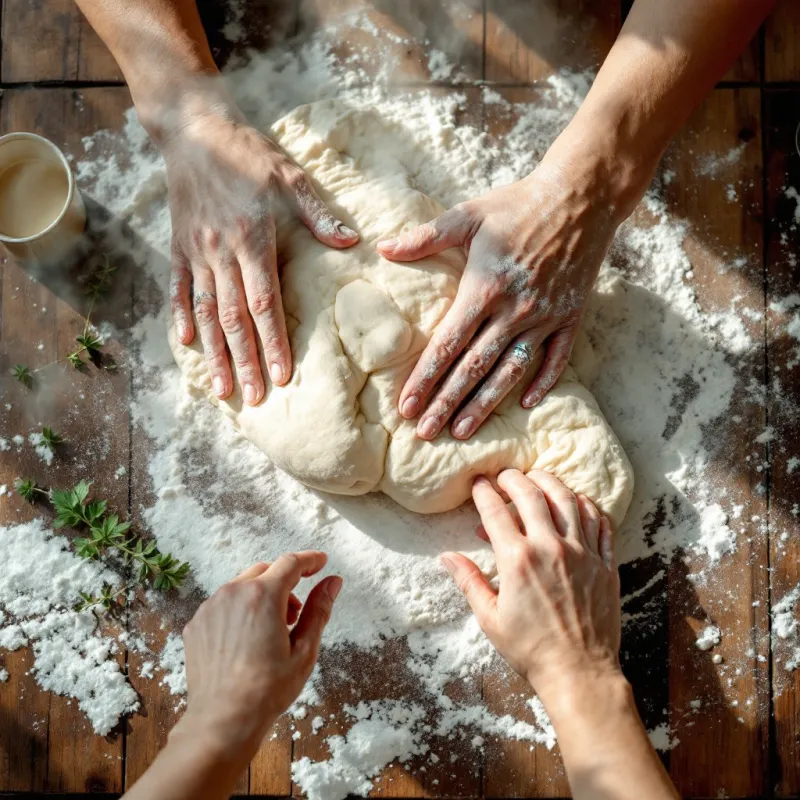
Photo: young adult baking sourdough bread rustic kitchen natural light flour hands, via images.stockcake.com
Let's get one thing straight: this isn't your grandmother's home cooking revival. Nobody's rolling out pie crust because they have to. They're doing it because it says something — about who they are, what they value, and how they want to live. In 2025, pulling a perfect golden loaf out of your own oven is less about feeding yourself and more about feeding a certain story.
And Americans are absolutely eating it up.
The Ultra-Processed Backlash Has a Kitchen
For years, the food industry sold convenience as aspiration. Frozen meals, meal kits, drive-throughs — speed was sophistication, and cooking from scratch carried a faint whiff of either poverty or quaintness. Then something shifted. As research into ultra-processed foods started bleeding from academic journals into mainstream conversation, and as social media gave everyone a stage to perform their daily rituals, the calculus flipped entirely.
Suddenly, knowing how to make your own pasta wasn't a throwback — it was a statement.
"There's a real cultural anxiety right now about what's in our food and where it comes from," says food writer and podcast host Simone Adler, based in Portland, Oregon. "Cooking from scratch is a way of opting out of that anxiety. It's control. And in a world that feels really out of control, control is incredibly appealing."
The numbers back her up. According to recent consumer surveys, scratch cooking among adults under 40 has risen steadily since 2020, with younger millennials and older Gen Z leading the charge. Specialty grocery stores report surging demand for whole grains, heritage flour varieties, and fermentation supplies. Home milling — grinding your own grain into flour — has gone from niche obsession to legitimate lifestyle category.
The Sourdough Starter Is Just the Beginning
If the pandemic introduced America to sourdough, the years since have taken that curiosity somewhere far more committed. People aren't just baking bread anymore — they're sourcing grain from specific farms, obsessing over hydration percentages, and building dedicated fermentation corners in their apartments.
Derek Huang, a 29-year-old graphic designer in Brooklyn, keeps three active starters in his refrigerator. Each one has a name. Each one produces a slightly different flavor profile depending on the flour blend he feeds it. "My coworkers think I'm unhinged," he admits cheerfully. "But there's something about the process — the waiting, the watching, the way it's never exactly the same twice — that I find genuinely meditative."
Derek posts his bakes on Instagram about once a week. The photos are beautiful: dramatic crust scores, crumb shots that look like architecture, steam wisping off a fresh loaf against the warm light of a well-appointed kitchen. The engagement is enthusiastic. "People ask me questions all the time," he says. "It's become this whole community."
And that community aspect is a big part of what's driving the trend. Home cooking, once a private and largely invisible domestic task, has found its public dimension. The kitchen has become a stage.
The Kitchen as Personal Brand
Walk through any major home goods retailer right now and you'll notice something: the aesthetic stakes for kitchen equipment have never been higher. Colorful Dutch ovens in heirloom shades. Handmade ceramic bowls from small-batch potters. Linen aprons that cost as much as a dinner out. The kitchen, once purely functional, is now deeply expressive.
"We've always used our homes to signal who we are," says cultural commentator and author Renata James, who writes about consumer behavior and identity. "The kitchen used to be the room you hid from guests. Now it's the room you show off first. That shift tells you everything about how cooking has been repositioned as a form of self-expression."
For many Americans, the cooking itself is inseparable from the sourcing story. Hyper-local ingredients — eggs from a nearby farm, honey from a rooftop beekeeper, vegetables from a CSA box — aren't just about flavor. They're narrative. They're the proof of a life lived intentionally, in opposition to the anonymous industrial food chain.
Simone Adler sees this as deeply tied to the slow food philosophy that's been percolating in food culture since the late 1980s but is now hitting genuine mainstream traction. "Slow food was always about pleasure and place and meaning," she says. "What's new is that it's become aspirational in a way that reaches beyond foodies. Regular people want that story too."
The Authenticity Economy Wants Your Sourdough
Not everyone is buying the romance of it all, of course. Critics point out that artisan home cooking is, at its core, a hobby of the privileged — it requires time, space, quality ingredients, and the kind of kitchen that photographs well. The $400 stand mixer and the $180 Dutch oven don't exactly democratize the movement.
Renata James acknowledges the tension. "There's a real irony in the fact that something positioned as a rejection of consumerism has become one of its most enthusiastic arenas," she says. "The authenticity economy is still an economy."
And yet, Derek isn't particularly interested in the critique. "I spend less money on food now than I did when I was ordering delivery every night," he points out. "The starter cost me nothing. The flour is cheap. Yeah, I bought a nice pan — but I've had it for three years."
For him, and for a growing number of Americans, the act of making something real with your own hands carries a kind of satisfaction that no restaurant meal or meal kit can quite replicate. It's slow. It's imperfect. It requires attention and patience and a willingness to fail.
In other words, it's the opposite of everything else competing for our time right now. And maybe that's exactly the point.
The new status symbol isn't what you bought. It's what you made.